
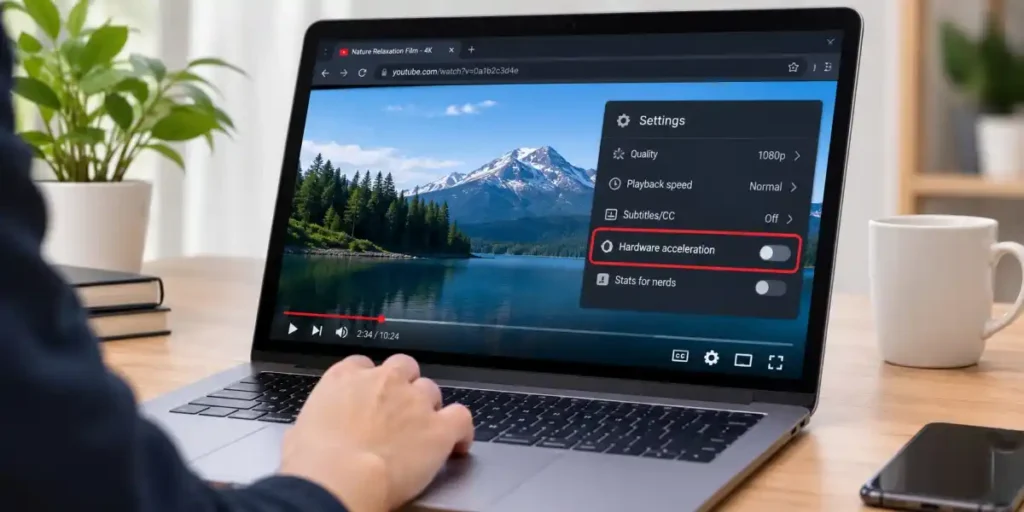
To eliminate frame drops, audio desync, and browser freezes during online playback, you must access your browser’s system parameters and disable the graphics processing delegation option. Knowing how to Turn Off Hardware Acceleration to Fix Web Video Lag instantly stabilizes your active video player container by forcing your main computer processor to manage visual decoding duties instead of overloading your dedicated graphics card. Leaving this feature active frequently results in severe rendering conflicts on public streaming indexes and video directories.
Here is the thing: browsers enable this toggle by default because it sounds great on paper. The feature splits heavy processing labor, handing video processing tasks over to your Graphics Processing Unit (GPU).
But it often breaks down in practice. If your computer utilizes an older integrated graphics chip, or if you just updated to a quirky display driver version, the handoff process fails. The player stutters, drops frames, or turns into a solid green block while the audio plays normally.
Why does hardware acceleration cause online video stuttering?
Standard video streaming relies on complex compression math called codecs to deliver high-definition footage across your internet connection. Your web browser must unpack this incoming data data stream in real time.
When your software encounters an embedded media engine on a heavy indexing site like NoodleMagazine, it shifts this math packet over to your GPU hardware lines. If your graphics card is already processing background tasks or lacks specific hardware support for that compression standard, the timing sequence completely breaks.
Let’s look at a concrete example. Suppose you are streaming a 1080p video clip at 60 frames per second while running a dual-monitor setup. If your browser tries to use a flawed driver script to paint those frames on your screen, your GPU usage can instantly spike to 100 percent capacity. This calculation bottleneck forces your browser tab to skip structural visual markers, transforming a smooth stream into a choppy slide-show mess.
How to Turn Off Hardware Acceleration to Fix Web Video Lag: Browser Guides
Fixing this processing bottleneck requires manually overriding your browser’s core resource settings. The modification is completely safe and can be reversed in seconds if your hardware setup demands it.
Disabling the feature inside Google Chrome
Google’s layout menu hides system options behind an advanced settings drop-down configuration block.
- Launch your browser window, click the three vertical dots located in the upper-right corner, and select Settings.
- Go to the left-side sidebar menu and click directly on the System panel link.
- Locate the setting labeled Use graphics acceleration when available.
- Slide the toggle switch to the Off position.
- Click the bright blue Relaunch button that appears right next to the toggle to refresh your browser process memory.
Modifying settings inside Mozilla Firefox
Firefox handles hardware allocation differently, grouping execution parameters under a performance optimization layer.
- Open the main program menu by clicking the three horizontal lines at the top right and choose Settings.
- Stay on the General panel tab and scroll down until you reach the Performance heading.
- Uncheck the box labeled Use recommended performance settings.
- A secondary option named Use hardware acceleration when available will instantly appear underneath.
- Uncheck that second box and restart your Firefox software to lock the settings change into place.
Adjusting parameters within Microsoft Edge
Microsoft’s native browser relies on the Chromium engine but separates its background processing features under a combined system tab.
- Open the main menu toolbar using the three horizontal dots and click into Settings.
- Look at the left navigation sidebar and click on System and performance.
- Move to the main panel and locate the toggle switch for Use graphics acceleration when available.
- Flip the switch off.
- Tap the Restart prompt to completely refresh your running background tasks.
What actually happens to your PC hardware when you toggle this setting?
Once you kill this feature, your web software shifts the entire burden of unpacking video streams directly onto your Central Processing Unit (CPU). Modern multi-core computer chips process this specific layout math with extreme ease.
| Technical Variable | Hardware Acceleration Turned ON | Hardware Acceleration Turned OFF |
|---|---|---|
| Primary Video Decoder | Graphics Processing Unit (GPU) | Central Processing Unit (CPU) |
| System Driver Dependence | Extremely high (Requires flawless GPU scripts) | Very low (Uses standard system memory blocks) |
| Common Player Errors | Solid green blocks, browser freezing, desynced audio | Slight increase in overall CPU temperature |
| Interface Stability | Fluctuates based on background app demands | Highly consistent rendering parameters |
Now, consider what happens on a mid-range business laptop. If you leave the setting on while tracking video files on public indices, your machine tries to use a generic corporate display driver to unpack high-bitrate media. Turning the feature off bypasses those buggy corporate driver files entirely, utilizing raw CPU power to guarantee clean frame synchronization.
Diagnostics: Identifying the true root cause of web video drops
Sometimes, video lag stems from broken server nodes rather than your local computer setup. Before you start tweaking internal options, you can check if your hardware is actually at fault.
Open a media stream, right-click directly inside the video player box, and select the option labeled Stats for nerds or Player Debug Info.
Watch the running tally for dropped frames closely over a 30-second window. If you notice that your system logs zero dropped frames but the timeline bar keeps spinning, your issue is caused by slow internet bandwidth or an overloaded media host. But if the dropped frame count climbs by 50 or 100 frames every time the camera switches angles, your browser’s graphics rendering pipeline is jammed, making a hardware acceleration adjustment absolutely necessary.
6. FAQ Section
Will learning how to Turn Off Hardware Acceleration to Fix Web Video Lag slow down my everyday web browsing?
No, it will not hurt your standard web browsing speeds. Modern computer processors feature multiple cores that handle standard text layouts, scripts, and static images instantly without needing a boost from your graphics hardware.
No, it will not hurt your standard web browsing speeds. Modern computer processors feature multiple cores that handle standard text layouts, scripts, and static images instantly without needing a boost from your graphics hardware.
Why does my video player turn into a solid green box during streaming sessions?
A solid green screen is a classic indicator of a total communication failure between your browser software and your graphics card driver. Turning off your hardware acceleration options stops this decoding loop, instantly restoring the normal image stream.
A solid green screen is a classic indicator of a total communication failure between your browser software and your graphics card driver. Turning off your hardware acceleration options stops this decoding loop, instantly restoring the normal image stream.
Is it necessary to update my computer’s graphics drivers after changing this browser setting?
While it is not strictly required to make the change work, keeping your display drivers updated through official channels like NVIDIA or AMD can fix the underlying software bugs that cause acceleration errors in the first place.
While it is not strictly required to make the change work, keeping your display drivers updated through official channels like NVIDIA or AMD can fix the underlying software bugs that cause acceleration errors in the first place.
Can this specific configuration change help fix audio desynchronization issues?
Yes, it fixes audio sync problems frequently. When a graphics chip falls behind on rendering physical video frames, the browser delays the video path to catch up, while the audio path continues running normally, causing a annoying playback lag.
Yes, it fixes audio sync problems frequently. When a graphics chip falls behind on rendering physical video frames, the browser delays the video path to catch up, while the audio path continues running normally, causing a annoying playback lag.
7. Conclusion
The single most effective takeaway is that disabling your browser’s hardware acceleration toggle forces your stable CPU to manage decoding, instantly bypassing faulty graphics driver lag during online streaming. Spending two minutes unchecking this single system option completely eliminates frustrating green screens and frame drops on heavy index sites.